How to Find and Read Your Massachusetts Consumer Confidence Report
A Consumer Confidence Report can look alarming when its tables list contaminants, limits, and detections without much context. The key is to find the report for the supplier serving your address, identify what was detected and how it compares with the applicable standard, then follow up on anything unclear. Here’s how to locate and read a Massachusetts report without mistaking a detection for a warning.
What a Consumer Confidence Report tells you
A Consumer Confidence Report, often called a CCR or annual water quality report, summarizes information about drinking water supplied by a community public water system. According to the Massachusetts Department of Environmental Protection (MassDEP), all community public water systems must prepare and provide an annual Consumer Confidence Report to their customers.
The report is meant to help you understand the quality of the water your supplier provides. It commonly includes information about the water source, treatment, detected contaminants, applicable standards, and any violations or related notices. The exact layout and level of detail can vary, so look for a report section that explains its tables and terms.
A CCR is useful, but it has limits. It describes the supplier’s water and the results included in that report; it does not necessarily describe the water at every individual faucet. Water may travel through local distribution pipes and building plumbing before reaching a tap. The report also may not answer a home-specific question, such as whether a particular fixture or service line affects water quality inside a building.
That distinction matters if you’re concerned about lead, a change in taste, or another issue at one address. A system-wide report and a household test answer different questions. For more detail on this difference, see Does the Town Water Report Reflect What Comes Out of Your Faucet? and Does a Service Line Inventory Show Whether Your Tap Water Has Lead?.
MassDEP explains that detecting a substance in a Consumer Confidence Report does not necessarily mean the water is unsafe to drink. A detection is a result to interpret, not a conclusion by itself. To understand what it means, check the reported level, the comparison standard, the monitoring period, and any explanation or corrective action described by the supplier.
The report is also not the same thing as an urgent water notice. An annual CCR reviews water quality information for a reporting period; a boil water order or other active advisory gives instructions for a current situation. If you are trying to understand an alert, use the supplier’s current notices rather than relying on an annual report. Annual Water Report vs. Boil Water Notice: Two Very Different Alerts explains the distinction.
Find the report for the supplier serving your address
The first challenge is often identifying the right supplier. A town name alone may not be enough. Some communities have more than one supplier, and a supplier’s service area may not match municipal boundaries. A rental resident may also need to distinguish the water supplier from a landlord, property manager, or billing contact.
Start with the water bill, if you have one, and look for the name of the water provider. If the bill combines water and sewer charges, check which organization supplies the drinking water; the sewer provider may be different. If you rent, ask the landlord or building manager for the supplier’s name, but confirm it through the water bill, an official notice, or the supplier’s official website when possible. Which Utility Actually Serves a Massachusetts Renter’s Address? covers ways to sort out that question.
Once you have a likely supplier, search its official website for terms such as “Consumer Confidence Report,” “annual water quality report,” or “drinking water quality report.” Look for the report that covers the previous calendar year rather than assuming the first search result is the newest or correct document. If the supplier serves multiple areas, check that the report covers your service area or system.
According to MassDEP, community public water suppliers must deliver annual Consumer Confidence Reports every July 1 for the previous calendar year. MassDEP also describes the requirement as annual drinking water quality reports delivered every July 1 for the previous calendar year. A report’s publication date and the period it covers are not necessarily the same: the report delivered in a given cycle summarizes the previous calendar year.
If you cannot find the report online, contact the supplier through the current contact details on its official website and ask for the report covering your address and the relevant calendar year. You can also ask whether the report is available in another format or language. Do not rely on a search-engine preview or a report for a nearby town if you cannot confirm it matches your supplier.
Use this quick check before reading:
| What to verify | Why it matters |
|---|---|
| Supplier name | Neighboring addresses may have different providers |
| Service area or system name | A supplier may publish separate reports for different systems |
| Reporting period | The report covers a defined past period, not necessarily current conditions |
| Publication or delivery cycle | A newer-looking page may link to an older report |
| Address or location coverage | A town-wide label alone may not confirm that your property is included |
| Report format and language | A readable copy may be available in a different format or language |
If you have a supplier name but not a report, ask directly for its annual Consumer Confidence Report. MassDEP states that a Public Water Supplier must provide an Annual Consumer Confidence Report about water quality. If the supplier’s website does not make the report easy to locate, ask how customers can access it and whether an updated copy is available.
For systems supplied through a regional or wholesale arrangement, the report may need a little more checking. A regional supplier’s information may describe treated water before it enters local pipes, while the local supplier’s report may cover the community’s system and distribution. MWRA Wholesale Results vs. Your Town’s Own Report: What Each Covers explains why these documents can have different scopes. If you are unsure which report applies, ask the local water supplier serving your address. Who Regulates Massachusetts Tap Water? MassDEP, DPH and Your Supplier offers context on the roles involved.
Read the report from the overview to the tables
It is tempting to jump straight to a contaminant table. Before doing that, read the introductory section. It usually explains where the water comes from, how it is treated, what the report covers, and where the supplier wants customers to look for additional information. That context helps you interpret the results instead of reading a table as a list of isolated hazards.
Identify the source and treatment information
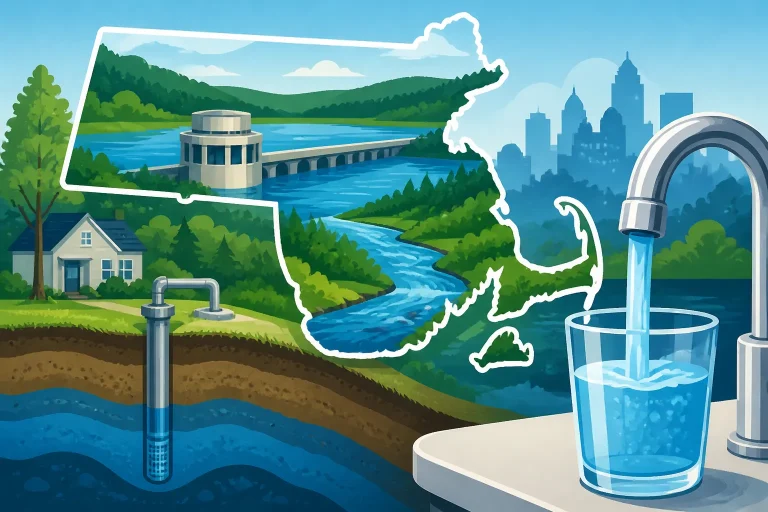
The report may describe a source such as a reservoir, river, or groundwater supply. It may also summarize treatment steps used before the water is delivered. These details can help you understand the system, but they are not a substitute for the contaminant results. Source information tells you where water originates; treatment information describes how the supplier manages it.
If a report names a source you do not recognize, avoid assuming that the water comes only from that location. A system may use more than one source or change how it operates. Ask the supplier how the report’s source information relates to your service area. For a broader look at Massachusetts supply sources, see Beyond MWRA: Reservoirs, Rivers and Wells Behind Massachusetts Taps.
Find the definitions beside the results
Reports often include terms such as “maximum contaminant level,” “action level,” “goal,” “range,” or “violation.” Read the report’s own definitions before drawing conclusions. Similar-sounding terms can mean different things. In particular, a comparison value or health goal is not automatically the same as an enforceable limit, and a detection does not by itself establish a violation.
The report should identify the standard or comparison value used for each result. If a term appears in the table but is not defined, check the explanatory notes or contact the supplier and ask what it means in that specific report. Action Level vs. MCL: Two Terms on Every Massachusetts Water Report can help clarify why these labels are not interchangeable.
Check whether results are current and comparable
Look for the monitoring period and any notes about sampling frequency. A result could summarize samples collected over a defined period, rather than a test taken on the day you read the report. Some entries may represent a range, an average, or another summary of monitoring results. The report’s notes should explain how to read the value and what period it covers.
Be cautious when comparing different reports. The tables may use different units, sampling periods, or reporting methods. A change in a number can reflect a real change in water quality, a different sampling approach, or a different way of presenting the result. Compare the report’s notes as well as the values. Comparing This Year’s Water Report With Last Year’s: What Changed? is useful when you want to understand a year-to-year difference.
Look for service line information
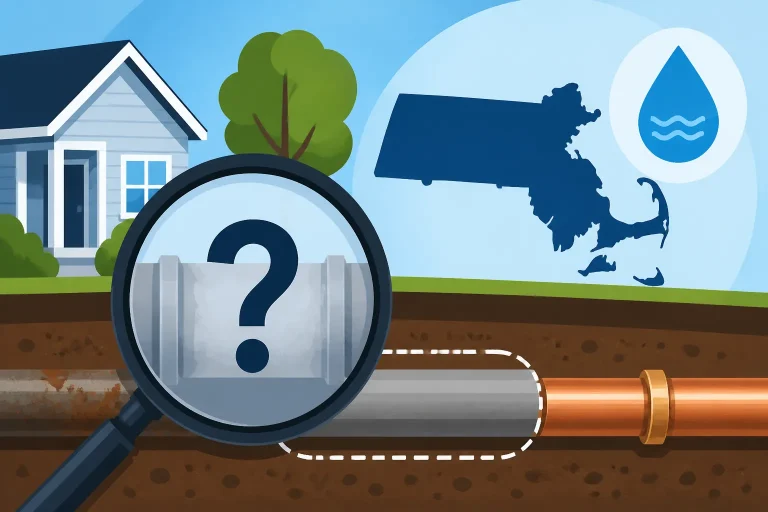
Some reports include instructions for finding the supplier’s service line inventory. According to MassDEP, Starting October 16, 2024, Community Public Water Systems must include inventory-access instructions in the Consumer Confidence Report. Those instructions can tell you where to look for information about the service line material recorded for an address.
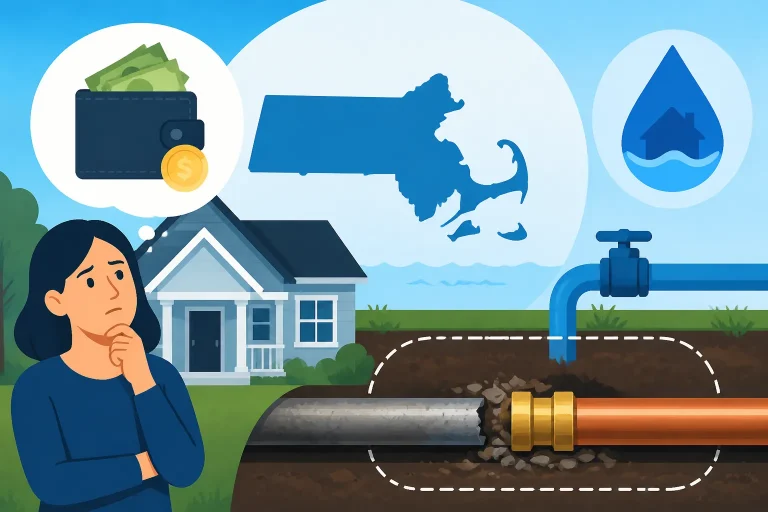
An inventory is not the same as a water test. It may identify a recorded material or indicate that the material is unknown, but it does not establish the amount of lead, if any, in water at a particular tap. If the inventory identifies a lead, galvanized, or unknown line, use the supplier’s instructions to find address-specific information and ask what steps are available. What Unknown Means in a Massachusetts Service Line Inventory and A Service Line Letter Arrived: Next Steps for Massachusetts Residents explain how to interpret those records.
Make sense of the contaminant table
The contaminant table is often the most technical part of the report. Take it one row at a time. A table may name a contaminant, show a result or range, list a standard or goal, identify a unit, and provide a note about monitoring or health effects. The column headings and footnotes are essential: a result without its unit or sampling context can be easy to misread.
Start with these questions:
- What substance is listed?
- What result does the report give, and what unit is used?
- Is the value a single measurement, a range, or a summary?
- What standard, goal, or other comparison value appears beside it?
- Does the report identify an exceedance, violation, or follow-up action?
- What do the table’s footnotes say about sampling and interpretation?
Do not compare values until you know they use the same units. If the report uses abbreviations or unfamiliar units, check its glossary or ask the supplier to explain them. mg/L, ppm, ppb: Units on a Massachusetts Water Lab Report can help with unit terminology, while Reading Water Test Results in Massachusetts: Limits and Benchmarks explains how different kinds of comparison values are used.
A detection is not automatically a safety finding
The word “detected” means that a substance was found in the reported sample or monitoring results. It does not, by itself, tell you whether a standard was exceeded or what the result means for your particular home. A result can be detectable and still be below a listed limit. Conversely, a report that requires further explanation should not be dismissed just because the value is unfamiliar.
MassDEP states that Detecting a substance does not necessarily mean the water is unsafe to drink. Read the result alongside the relevant standard, and check whether the supplier reports an exceedance or violation. The report’s explanatory text should provide context; if it does not, ask the supplier what the value represents and whether any action is needed.
Avoid treating a long contaminant list as a ranking of danger. The presence of a chemical name in a table is not enough to determine risk. The value, comparison standard, exposure context, and report notes all matter. For health questions about a specific contaminant or personal exposure, contact your local health department or a medical professional.
Understand the difference between a limit, a goal, and a detection
A report may present more than one comparison value. A maximum contaminant level is a regulatory limit; a goal may represent a different type of benchmark. An action level, where applicable, is also a distinct term with its own meaning. The report should say which value applies to the result and how compliance is determined.
This is why a simple “result versus number” reading can mislead. A value printed near a health goal may not mean the same thing as a value above a regulatory limit. Likewise, a result below a standard does not mean that every individual tap has been sampled. Detected Is Not Unsafe: Reading a Massachusetts Water Report Table provides further guidance on distinguishing a detection from a conclusion.
Some table entries may be presented as ranges or calculated values rather than as one sample result. Follow the report’s definitions and notes. If a table combines results from multiple samples or locations, the reported figure may be intended to summarize the system rather than characterize a single household. How Running Averages Decide Whether One High Sample Is a Violation explains why a reported summary can differ from one individual measurement.
Read notes about monitoring and sampling
The table may include a monitoring period, a sample location, or a note explaining that a result comes from earlier testing. The report may also state that monitoring was not required during a particular period or that the listed value represents a prior result. These details can affect how current and comparable the result is.
If a result seems unexpectedly old, do not assume that no monitoring has occurred or that the water has changed. Ask the supplier what period the result covers and whether more recent monitoring information is available. A CCR is an annual summary, but the supplier may be able to explain a table entry or direct you to a separate notice. For a home-specific question, a separate test may be more informative than a system-wide summary.
Understand violations, exceedances, and corrective actions
A report may describe an exceedance, a violation, or another issue requiring explanation. These terms should not be treated as interchangeable. Read the supplier’s wording carefully and look for the relevant contaminant, standard, dates or monitoring period, and description of what happened. The report should explain whether the issue has been corrected, remains under follow-up, or requires customer action.
According to MassDEP, if something is detected above the maximum level, the supplier must discuss the potential health effects, and actions taken to correct the problem. Look for that explanation near the table entry or in a separate notice section. The supplier’s discussion can help distinguish the result from the response: what was found, what it means under the applicable standard, and what the system did in response.
A violation notice does not automatically tell you what to do at home today. Check whether the report gives current instructions, and confirm active notices with the supplier. If the report describes an ongoing concern but does not make the next step clear, contact the supplier and ask whether customers should take any action now. If the issue raises a health question for you or a family member, consult a local health department or medical professional.
It is also important to distinguish a past reporting-period issue from a current advisory. A report may describe an issue that has already been addressed, while a current notice may apply now. Conversely, an annual report is not a reason to ignore a recent supplier alert. For alert-specific guidance, see Where to Get a Reliable Update on a Massachusetts Water Notice and Any Active Water Advisory in Your Town? Searching MassDEP’s Database.
If the supplier reports no violations, read that statement in context. It is reassuring information about the supplier’s compliance reporting, but it does not prove that every faucet, building pipe, or household fixture has been tested. A household concern may still merit a direct question, plumbing evaluation, or appropriately selected water test. The report describes the water system and monitoring summarized there, not every possible condition inside a home.
Know what the report can’t tell you about your tap
A community water report is valuable for understanding the supplier’s system, but it is not a household inspection. Water can be affected by plumbing between the supplier’s main and a building’s tap, including service lines, indoor pipes, and fixtures. The supplier’s report may not include a sample from your kitchen faucet.
This is especially relevant when the concern is lead. A system-wide lead result is based on the supplier’s monitoring and reporting methods; it does not establish the lead level in every home. A service line inventory can provide useful information about recorded pipe materials, but it also is not a tap-water result. To understand a home-specific lead concern, you may need to ask about testing options and how samples are collected. Getting a Home-Specific Lead Answer for Your Massachusetts Tap explains the distinction.
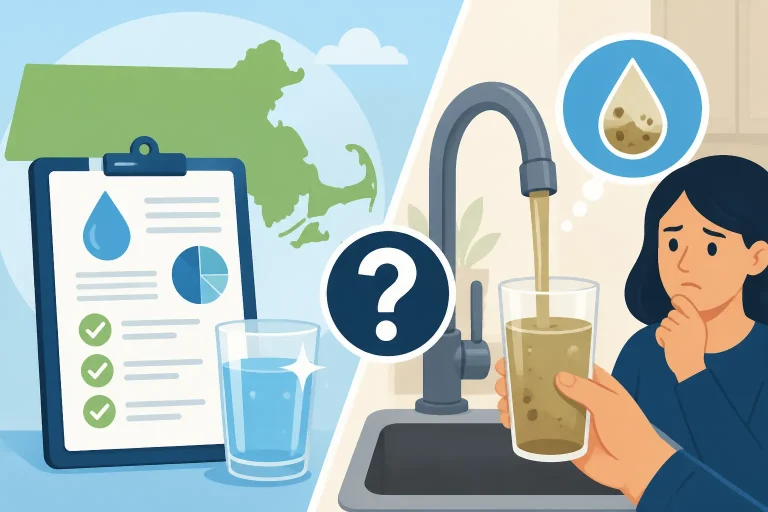
The same principle applies to taste, odor, color, or staining. A CCR may help you understand the supplier’s reported water quality, but it may not explain a problem limited to one building or faucet. If the change is isolated to one tap, the cause may be associated with plumbing or fixtures; if multiple homes are affected, a supplier issue may be worth checking. Report a new or persistent concern to the water supplier and ask whether other customers have reported it. Is It Just Your House? Sorting Out a Massachusetts Tap Water Problem offers a way to think through that question.
A CCR also does not test for every possible substance or every possible household condition. The report shows what it includes for the reporting period. If you use a private well, a public supplier’s report does not describe your water; private well owners need to use well-specific testing and local guidance. See How to Identify the Water Source Serving a Massachusetts Home if you are unsure whether your address is on public water or a private well.
For a household test, first decide what question you are trying to answer. A test for lead, bacteria, or another concern must be selected and collected appropriately; a general test may not cover the contaminant you care about. How to Get Water Tested in Massachusetts: Labs, Samples and Results explains how to approach testing, and Should a Water Test Come Before a Filter Purchase in Massachusetts? covers why results should guide treatment choices.
What to do after reading your report
A useful next step depends on what the report says and what prompted you to look it up. You do not need to interpret every table entry as a personal warning. Focus on the information relevant to your supplier, your question, and any action the report asks customers to take.
Use this practical review:
- Confirm that the report names the supplier serving your address.
- Check which calendar year and system the report covers.
- Read the source, treatment, and definitions before interpreting the tables.
- For each result of concern, note the unit, comparison value, monitoring period, and footnotes.
- Look for any reported violation, exceedance, health-effects discussion, or corrective action.
- Check whether the report gives instructions for accessing the service line inventory.
- Contact the supplier if the report’s wording or coverage is unclear.
- Use a separate household test or plumbing review when the question is specific to your home.
When contacting the supplier, make the question specific. Instead of asking whether the water is “safe” in general, ask what a particular table entry means, which standard it is compared with, what period the result covers, and whether there is a current notice or recommended customer action. If you are checking a service line, ask how to find the record for your address and what to do if its material is unknown.
If you are considering a filter, do not choose one based only on the presence of a contaminant name in the report. Match any treatment product’s certification and reduction claim to the contaminant and result you are trying to address, and check that the certification applies to the specific model. A filter can be designed to reduce certain substances but is not a substitute for interpreting an active supplier notice or following its instructions. Matching a Water Filter to the Problem in a Massachusetts Home and Filter Certification, Explained for Massachusetts Shoppers can help you assess the match.
Keep the report for reference and compare it with the next edition when available. If a value or explanation changes, check whether the supplier also changed its sampling, source, or reporting method. A difference between reports may deserve a question, but it is not automatically evidence of a worsening condition. The report’s notes and the supplier’s explanation provide the context.
Most of all, separate three questions that often get blended together: What did the supplier report? What does that result mean under the relevant standard? And what is happening at my own tap? The CCR is an important starting point for the first two. A supplier inquiry, current notice, or home-specific test may be needed to answer the third.
Frequently Asked Questions
When should I look for a new Massachusetts Consumer Confidence Report?
According to MassDEP, community public water suppliers must deliver annual reports every July 1 for the previous calendar year. Check the supplier’s official website or ask the supplier for the report covering the relevant period.
Does a contaminant detection mean my water is unsafe?
No. MassDEP says that detecting a substance does not necessarily mean the water is unsafe to drink. Read the result with its comparison standard, monitoring information, and any explanation from the supplier.
Does the report tell me whether my home has a lead service line?
Not necessarily. The report may include instructions for accessing an inventory, but an inventory is not a tap-water test. Use the supplier’s inventory instructions and ask about address-specific information.
What should I do if the report says a maximum level was exceeded?
Read the supplier’s explanation for potential health effects and actions taken to correct the problem. Check for current instructions, and contact the supplier if you cannot tell whether any action is needed now. For personal health questions, contact a local health department or medical professional.
Sources
- Massachusetts Department of Environmental Protection (checked November 13, 2026)
- Massachusetts Department of Environmental Protection (checked November 13, 2026)
- Massachusetts Department of Environmental Protection (checked November 13, 2026)
Disclaimer
This article is for general informational purposes only and does not constitute professional advice. Laws, prices and regulations vary by location and change over time. Consult a qualified professional for guidance on your specific situation. Massachusetts Water Guide is not a government agency or water utility and is not affiliated with any public water system.