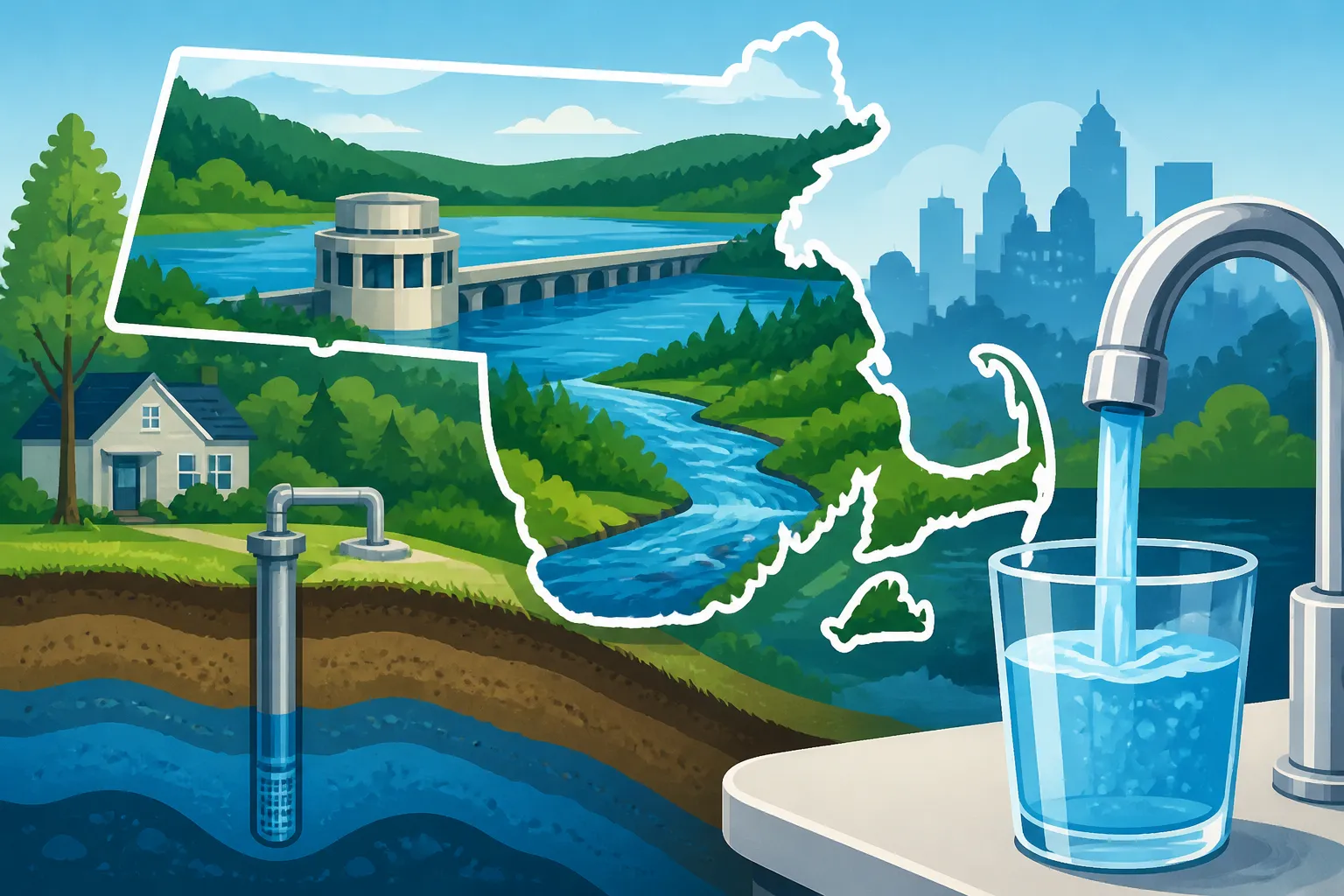
Beyond MWRA: Reservoirs, Rivers and Wells Behind Massachusetts Taps
Massachusetts tap water does not come from one statewide source. Some communities rely on regional supplies, while others draw from their own reservoirs, rivers, wells or a mix of sources. Knowing which system serves your address helps you find the right water report and understand why taste, treatment and local water notices can differ.
Massachusetts water comes from more than one system
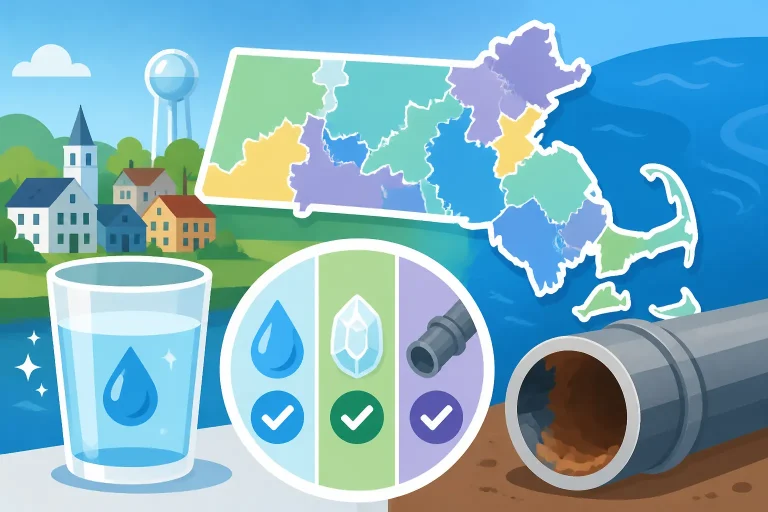
It is easy to think of Massachusetts tap water as a single product. But water reaching homes across the state can begin in very different places. A community may rely on its own surface-water supplies, groundwater wells or water purchased from a regional supplier. Some systems combine sources or change which sources they use.
That variety matters because the source shapes the path water takes before it reaches a tap. Water collected in a reservoir or drawn from a river is surface water. Water pumped from a well is groundwater. A regional supplier may treat water before selling it to a local community, which then manages delivery through its own pipes. In other places, a local water department may oversee the supply from source through distribution.
The Massachusetts Water Resources Authority, often called the MWRA, supplies wholesale water to some communities. It is an important part of the state’s water picture, but it is not the source for every Massachusetts address. A resident outside an MWRA community may receive water from a town or city system, a regional supplier other than the MWRA, or a private well. Even within a community, service boundaries and supplier arrangements can make the answer less obvious than a town name suggests.
The distinction is useful when you are trying to answer practical questions:
- Who should you contact about a sudden change in taste or appearance?
- Which annual water report describes your supply?
- Does the report cover water from a regional supplier, a local source, or both?
- Could a neighbor receive water from a different source?
- Is your home connected to public water, or does it rely on a private well?
Start with the address, not an assumption about the town. A municipality can have more than one supplier, and the boundary of a water system does not always match the boundary of a town. If you are unsure which utility serves a rental or a particular property, Which Utility Actually Serves a Massachusetts Renter’s Address? explains how to confirm the supplier.
Water-source differences are also a reason not to treat one town’s report as a statewide summary. A report describes a defined system and the water it supplies; it does not automatically tell you what is happening in a neighboring community. For more on the role of MWRA alongside local systems, see Beyond MWRA: Reservoirs, Rivers and Wells Behind Massachusetts Taps and MWRA Wholesale Results vs. Your Town’s Own Report: What Each Covers.
Reservoirs, rivers and wells each shape a supply
Surface water and groundwater are both used for drinking-water supply, but they begin in different settings and present different management questions. The label on a source is only the start of understanding it. The water still needs to be collected, treated as needed, checked and delivered through a system of pipes.
Reservoirs and other surface-water sources
A reservoir stores water for later use. It may collect rainfall and runoff from the surrounding landscape, or be part of a larger network of connected water bodies. A supplier may draw water from a reservoir directly or use other surface-water sources as part of its supply.
Rivers and streams can also serve as sources, either by themselves or as part of a system that moves water into storage or treatment. Surface-water quality can vary with conditions in the watershed, such as rainfall, runoff and changes in the source environment. A water provider manages those conditions through source protection, monitoring and treatment practices appropriate to its system.
Local supplies can be more complex than a single lake or reservoir. According to Worcester Department of Public Works, Worcester obtains drinking water from 10 surface water sources. That description is a useful reminder that even a city’s supply may involve a collection of sources rather than one identifiable reservoir.
The Cambridge supply illustrates a different arrangement. According to City of Cambridge Water Department, the Cambridge drinking water supply comes from the Cambridge reservoir system. The source name tells you where the supply begins, but a complete understanding also involves the treatment and distribution arrangements that carry water to customers.
These examples should not be generalized to other cities. A source configuration that applies to Worcester or Cambridge does not establish what supplies a nearby town, a neighboring water district or a particular street. Check the report and supplier information for the address you care about.
Groundwater wells
A groundwater system pumps water from an underground aquifer through a well. The water may have moved through soil or rock before reaching the well, and the characteristics of groundwater can differ from those of surface water. For example, mineral content can vary with local geology. The supplier may treat the water to address the characteristics found in that system.
A well serving a public water system is not the same thing as a private household well. Public systems are managed by a supplier for the customers they serve. A private well is generally managed by the property owner, with local requirements and responsibilities that can differ from public water arrangements. If your home is on a private well, an annual report from a nearby town utility may not describe your water. The article How Massachusetts Private Wells Draw Groundwater, and Who Is in Charge explains that separate situation.
A public system may also use multiple wells or combine groundwater and surface water, depending on how it is built and operated. That is why a source description should be read as a starting point, not as a complete water-quality result. A source tells you where water comes from; treatment, system monitoring and the condition of local plumbing also influence what reaches a tap.
A mix of sources
Some suppliers can draw from more than one source. That flexibility may help a system manage its supply, but it can also mean the water characteristics are not identical at all times. A change in source or treatment can sometimes be noticeable to customers, particularly in taste or smell. A sensory change alone does not identify the cause or establish whether there is a health concern.
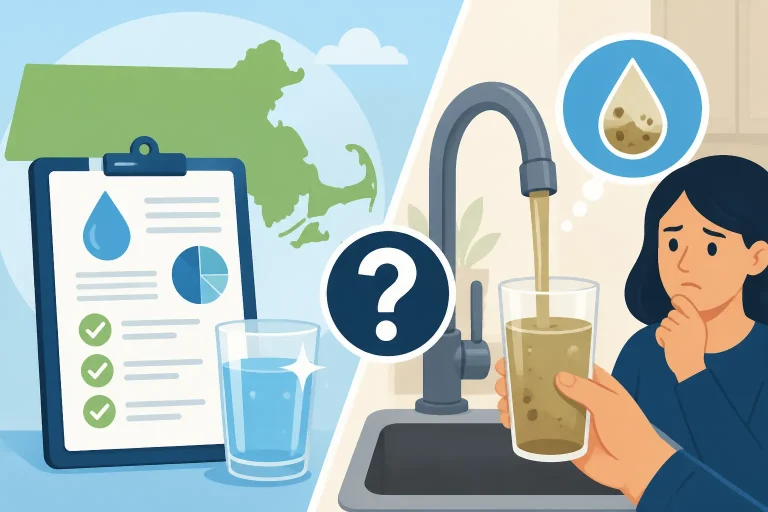
If a new taste, smell or appearance is affecting your water, first check whether the supplier has reported work, a source change or a water notice. Then describe the issue to the supplier, especially if it is persistent or affects more than one tap. When Massachusetts Tap Water Looks, Smells or Tastes Off: A Guide offers a way to sort out common possibilities and decide what information to gather.
How source water becomes tap water
Water does not travel directly from a reservoir, river or well to a kitchen faucet. A public supply typically follows a chain: source, treatment, storage, distribution and building plumbing. The details vary by system, so a general description cannot replace the supplier’s own report or operating information.
Collection and treatment
A surface-water system collects water from its source and directs it toward treatment. A groundwater system pumps water from a well and routes it through the treatment steps used by that supplier. Treatment is selected for the water and system conditions; there is no single treatment sequence that applies to every Massachusetts supply.
Treatment can involve processes that remove particles, manage microorganisms or adjust water chemistry. Some systems disinfect water, while the exact methods used depend on the supplier. A community buying water wholesale may rely on treatment carried out by the regional supplier, while still managing local storage and pipes. Another community may operate its own treatment facilities.
The distinction between wholesale and local roles can be important. A regional supplier can treat water before it reaches a town, but the town’s distribution system carries it onward to local customers. Questions about a source or treatment plant may belong with one organization, while questions about a local main, meter or building connection may belong with another. For a fuller overview, see Who Regulates Massachusetts Tap Water? MassDEP, DPH and Your Supplier and Wholesale MWRA Water, Local Pipes: Who Handles Which Part of Delivery.
A water report can help explain which sources and treatment practices are associated with a system. It may also describe monitoring results and any issues the supplier must disclose. Reports use technical terms and may group results in ways that are easy to misread. How to Find and Read Your Massachusetts Consumer Confidence Report can help you locate the report and interpret its sections.
Storage and distribution
After treatment, water may be stored before being sent through a network of pipes. Distribution mains carry it through streets; service lines connect a building to the system; and indoor plumbing completes the route to the tap. The source water can meet the supplier’s requirements while the plumbing between the main and a faucet still affects the water at that particular location.
This is one reason a town-wide report cannot answer every home-specific question. A report describes results for a public water system or part of a system, not necessarily the condition of every faucet, service line or indoor pipe. Older plumbing, a building’s layout, stagnant water in a fixture and work on nearby pipes can all be relevant when a concern is limited to one property.
If you are trying to understand whether a problem starts in the public system or inside the building, compare more than one cold-water tap and ask nearby residents whether they notice the same thing. A problem affecting only one fixture may point toward a local plumbing issue, although it does not prove the cause. Smell at Only One Faucet? When the Plumbing Is the Likely Culprit covers that distinction.
The last stretch to the faucet
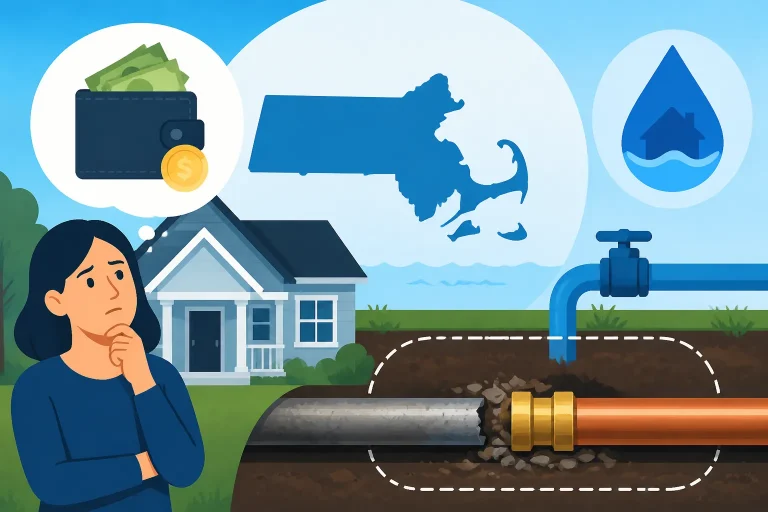
Water suppliers manage the public system, but they do not control every pipe in a home. The service line may have different ownership or maintenance responsibilities along its route, and indoor plumbing is part of the property. For issues such as lead, an inventory or a general report does not necessarily establish the water quality at a particular tap. A home-specific test and an understanding of pipe materials may be needed.
Source information still matters, but it answers a different question from a tap test. The source tells you where the system gets water. The report describes system-level monitoring and other disclosures. A sample collected from a particular tap can provide information about that sampling location and conditions. None of these pieces, on its own, answers every question about a home.
For the difference between the town report and a home’s actual faucet, see Does the Town Water Report Reflect What Comes Out of Your Faucet?. If your concern is lead, Getting a Home-Specific Lead Answer for Your Massachusetts Tap explains why source and system results do not replace an assessment of the home plumbing.
Find the supplier and report for your address
The most useful first step is to identify the water supplier that serves the property. Do not rely only on the town name, a neighbor’s bill or a report found through a general search. The property may be served by a local department, a district or a regional arrangement. A private well changes the route entirely.
Confirm the supplier
Look at a recent water bill if one is available. The supplier name or billing information can provide a starting point. For a rental, ask the landlord or property manager which system serves the building, then verify the answer with the supplier if anything is unclear. A utility’s official website is a good place to find current service-area information and contact details.
If you are buying a home, ask the seller or agent whether the property is connected to public water or a private well. Do not assume that nearby houses share the same supply. If the property has a well, ask for the well’s test history and any treatment records rather than relying on a public-water report for the town.
If there are multiple possible suppliers, give the utility the full service address and ask which system serves it. That can prevent a common mistake: reading an annual report for the right town but the wrong water system. Two Water Suppliers in One Massachusetts Town: Whose Rules Apply? and Is Your Massachusetts Address in a Bedrock Arsenic Probability Zone? address different ways a town name may not be enough to identify the relevant water information.
Locate the right annual report
Once you know the supplier, look for its most recent annual water quality report, sometimes called a Consumer Confidence Report. The report should match the system that serves the property. If a community receives wholesale water, its local report may include local information in addition to results from the wholesale supplier. Do not assume that a regional report covers all local distribution details.
When reading a report, look for:
- The system name and service area.
- The sources of water identified by the supplier.
- The treatment description.
- Monitoring results and the units used.
- Any notices, violations or explanations of unusual results.
- Contact information and instructions for requesting more detail.
A report may list a contaminant as detected even when the reported result is within the applicable standard. Detection and a standards violation are not the same thing. Read the report’s notes, units and comparison values together rather than focusing on one table entry. Detected Is Not Unsafe: Reading a Massachusetts Water Report Table explains this distinction.
Reports describe a defined set of system data. They do not guarantee identical conditions at every tap, and they may not cover a private well. If a report is unclear about whether results apply to a regional supply, a local system or both, ask the supplier to explain the boundary of the report and which parts of the delivery chain it covers.
Ask a focused question
A specific question is more likely to get a useful answer than a broad request such as “Is my water safe?” Consider asking:
- Which public water system serves this address?
- What source or sources are currently used for that system?
- Does the annual report cover the local distribution system as well as any wholesale water?
- Has the supplier reported a recent source change, treatment change or service interruption?
- Is there an active water notice for this address?
- If the problem seems limited to my building, what information should I provide?
If the issue concerns a particular taste or smell, explain when it began, whether it affects hot water or cold water, and whether it occurs at one faucet or several. If it concerns discoloration, mention whether it appeared after construction or water-main work. These details help distinguish a broad system issue from a building-specific one, though they do not diagnose the cause.
For a notice that may be active, check the supplier’s current official updates rather than relying on an old report or an unverified social post. Where to Get a Reliable Update on a Massachusetts Water Notice can help you look for current information. An annual report is a periodic summary, not a live alert system.
Why water can differ from one community to the next
Two neighboring homes may receive water that differs in source, treatment, mineral content or distribution path. The difference may be noticeable as taste or hardness, or it may not be detectable by sight, smell or taste at all. The town line itself does not explain the difference; the systems and plumbing serving each address do.
Different starting sources
A community that uses surface water has a different source setting from one that pumps groundwater. Surface water reflects conditions in a watershed and storage system; groundwater reflects the aquifer and local geology. The supplier’s treatment process is chosen for its source and operational needs, so treatment can differ too.
A town may also draw from several sources, while another relies on a single identified system. As Worcester and Cambridge demonstrate, source arrangements can differ even among cities. Those examples describe those particular supplies, not a general rule for the rest of Massachusetts.
A regional supplier can further complicate comparisons. A town buying wholesale water may receive water treated outside its own community, then distribute it through local pipes. Another town may manage its supply independently. To see how this changes what a report covers, compare Local Pipe Results a Wholesale Water Summary Leaves Out with Served by an MWRA Community? How to Request Your Local Water Report.
Different treatment and distribution
The treatment method and the way water moves through a system can influence its characteristics. Disinfectant residual, mineral content, and contact with pipes or fixtures can all affect what a customer notices. A difference in taste between towns does not, by itself, show that one supply is better or worse.
Water can also change as it travels through local infrastructure. Main repairs, hydrant flushing or a building’s plumbing can produce temporary changes in appearance or taste. If a change begins after visible work in the street, check for an update from the supplier and ask whether the work could be related. After Hydrant Flushing in Massachusetts: Running the Cold Tap Clear and Rusty or Orange Water After Water Main Repairs in Massachusetts discuss those situations.
Changes that persist, recur or affect multiple neighbors are worth reporting to the supplier. A sudden change in one faucet may have a different explanation from a widespread change. For a structured way to compare those possibilities, see Is It Just Your House? Sorting Out a Massachusetts Tap Water Problem.
Different building plumbing
The public water system is only part of the route. A home’s service line, interior pipes, faucet and fixtures can influence water at the tap. Buildings of different ages or with different plumbing materials may have different concerns even when they receive water from the same public system.
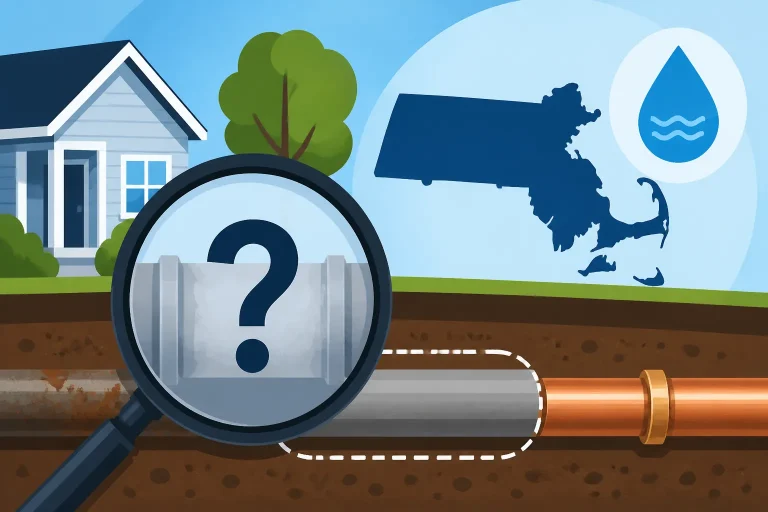
This is particularly important when researching lead. A supplier’s report or service-line inventory can provide useful system information, but it may not identify every pipe inside a home or answer what is present in a specific sample. If a line’s material is unknown, or if a home has older plumbing, use the supplier’s information as one part of the investigation rather than a final answer. Does a Service Line Inventory Show Whether Your Tap Water Has Lead? explains what an inventory can and cannot establish.
The same caution applies to water quality concerns that are not visible. Many contaminants have no distinctive taste, smell or color. A water report or properly selected laboratory test is more informative than appearance alone. For issues that require testing, How to Get Water Tested in Massachusetts: Labs, Samples and Results describes how to approach sampling and results.
A practical way to investigate your water source
You do not need to become a water-system specialist to find out where your tap water comes from. A few targeted checks can establish the supplier, point you to the right report and help you decide whether a concern belongs with the utility, a building owner or a laboratory.
- Start with the property. Confirm whether it uses public water or a private well. If it is a rental, ask the landlord or property manager and verify if the answer is uncertain.
- Identify the supplier. Use a recent bill or the supplier’s official website. If more than one system serves the town, ask which one covers the specific address.
- Find the matching report. Make sure the report names the system that serves the property. Check the source, treatment and monitoring sections rather than relying on a summary from another town or supplier.
- Separate source questions from tap questions. A source description tells you where water begins; it does not establish the condition of indoor plumbing or the result at a particular faucet.
- Check current notices separately. A report is not a real-time update. Use the supplier’s official communication channels for current interruptions, advisories or work.
- Describe the issue carefully. Note whether the change affects one faucet or several, whether it is limited to hot or cold water, and when it began. Ask neighbors whether they notice it too.
- Escalate appropriately. Contact the supplier for system-wide questions or a change affecting multiple properties. Contact the landlord or building manager when plumbing or building operations may be involved. For a private well or home-specific contaminant question, consider a suitable water test.
This approach also helps avoid two common mistakes. The first is assuming that a report for a nearby community applies to your address. The second is treating the source as the whole story. Source water is important, but so are treatment, the public distribution system and the plumbing inside the property.
If results or notices raise a health question, ask the local health department or a medical professional rather than drawing conclusions from taste, odor or a single number in a report. For more on how an annual report differs from a notice that calls for a specific response, see Annual Water Report vs. Boil Water Notice: Two Very Different Alerts.
The central question is simple: which system supplies this address, and what does that system’s own information say? Once you know that, it becomes easier to decide whether to review a report, contact the supplier, investigate building plumbing or arrange a home-specific test.
Frequently Asked Questions
Does every Massachusetts community get water from the MWRA?
No. Some communities use MWRA water, while others rely on local or other regional supplies. Confirm the supplier for the specific address rather than assuming based on its town.
Does the name of a reservoir tell me everything about my tap water?
No. It identifies part of the source story, but treatment, distribution pipes and building plumbing also matter. A source description is not a test result for a particular faucet.
Can a neighbor’s water report answer questions about my home?
Not necessarily. The neighbor may have a different supplier or distribution system, and a public report does not describe every home’s plumbing. Find the report for your own service address.
What should I do if my water tastes or looks different?
Check the supplier’s current updates, note whether the change affects one tap or several, and contact the supplier if the change persists or appears widespread. A sensory change alone does not identify its cause.
What if my home uses a private well?
A public water supplier’s annual report generally does not describe a private well. Ask about the property’s well-testing history and consult guidance specific to private wells.
Sources
- Worcester Department of Public Works — Water Quality Report (PDF) (checked November 13, 2026)
- City of Cambridge Water Department — 2025ANNUALDRINKINGWATERQUALITYREPORT (PDF) (checked November 13, 2026)
Disclaimer
This article is for general informational purposes only and does not constitute professional advice. Laws, prices and regulations vary by location and change over time. Consult a qualified professional for guidance on your specific situation. Massachusetts Water Guide is not a government agency or water utility and is not affiliated with any public water system.